
Daily affirmations are short, intentional statements that reinforce values, reshape self-talk, and support steady personal growth. When they’re written in a believable way and paired with small, consistent actions, they can become a practical anchor—helping you return to what matters, even on busy or stressful days. Below is a clear breakdown of what affirmations are, why they can help, how to write your own, and a simple routine for making them stick.
Affirmations are present-tense statements that reinforce identity, values, and chosen behaviors. Think: “I practice,” “I choose,” or “I am becoming.” They work best as a practice paired with reflection and follow-through—not as a replacement for problem-solving, medical advice, or professional mental health care.
A helpful mindset is to treat affirmations as attention guides. Repetition, emotional engagement, and small actions are what turn supportive language into real change over time. Common misconceptions include “just say it once,” “fake it till it’s true,” or “ignore negative emotions.” The goal isn’t to deny reality—it’s to direct your next best step.
Affirmations have a stronger foundation than “positive vibes.” Research on self-affirmation suggests that reflecting on core values can reduce defensiveness and improve openness to change and learning. The American Psychological Association summarizes how self-affirmation supports psychological flexibility in daily life (APA overview).
They also pair well with habit formation and neuroplasticity-friendly routines: repeated attention patterns can strengthen preferred mental pathways over time. When you use identity-based language (“I am someone who…”), it becomes easier to make consistent choices because your behavior is connected to who you’re becoming, not just what you want.
Finally, affirmations can support emotion regulation. A grounding line during stress can interrupt spiraling thoughts and help you re-center—especially when combined with a slow exhale. Harvard Health also notes that positive thinking practices can help people cope with stress more effectively (Harvard Health Publishing).
| Goal | Affirmation focus | Example statement | Best time to use |
|---|---|---|---|
| Confidence | Capability + evidence | I handle challenges one step at a time, and I learn quickly. | Before a difficult task |
| Consistency | Identity + routine | I keep promises to myself, even in small ways. | Morning planning |
| Resilience | Self-compassion | I can feel this and still move forward with care. | After setbacks |
| Calm | Breath + safety cues | I am safe in this moment; I can slow down and choose. | During stress spikes |
The fastest way to make affirmations effective is to remove “inner resistance.” If a line feels wildly untrue, your mind often argues back. Instead, write statements that are both encouraging and realistic.
A quick formula that tends to work: I choose (value) by (small behavior) today. Example: “I choose self-respect by speaking clearly and kindly today.”
Consistency beats intensity. A routine that fits into real life will outperform a perfect plan you never repeat.
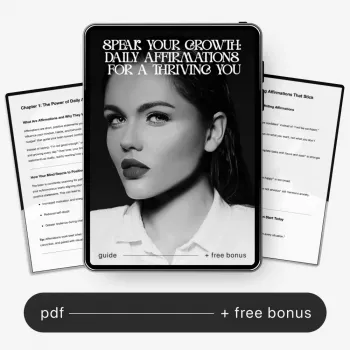
If you want a ready-made structure to reduce decision fatigue, the guided workbook Speak Your Growth: Daily Affirmations for a Thriving You is built for quick daily use—so you spend less time figuring out what to say and more time practicing it.
Rotate themes based on what you need most right now. Keep the language simple, specific, and kind.
For goal-driven seasons, pair affirmations with a system that turns intention into steps. Educators often like Aim High, Teach Bold to translate mindset into weekly SMART goals that feel doable.
If your growth focus is building something tangible (a side hustle, a brand, a long-term asset), affirmations pair well with a roadmap like From Hustle to Holding, which helps you align daily effort with long-range outcomes.
If identity alignment is part of your growth journey, it can help to reflect it visually too. The guide Define Your Style With a Mood Board is a practical way to connect self-concept, confidence, and everyday choices—so your affirmations match how you show up.
Three to five core affirmations is a strong daily baseline. Choose one main line to repeat throughout the day and prioritize consistency over volume.
Lower the intensity (“I’m learning to…”), add compassionate phrasing (“Even with doubt, I choose…”), and include evidence-based wording. Pair the statement with a slow grounding breath, and consider professional support if distress persists.
Morning works well for setting intention, midday for emotional regulation, and evening for reflection. Linking the practice to an existing habit makes it easier to keep going.






Leave a comment