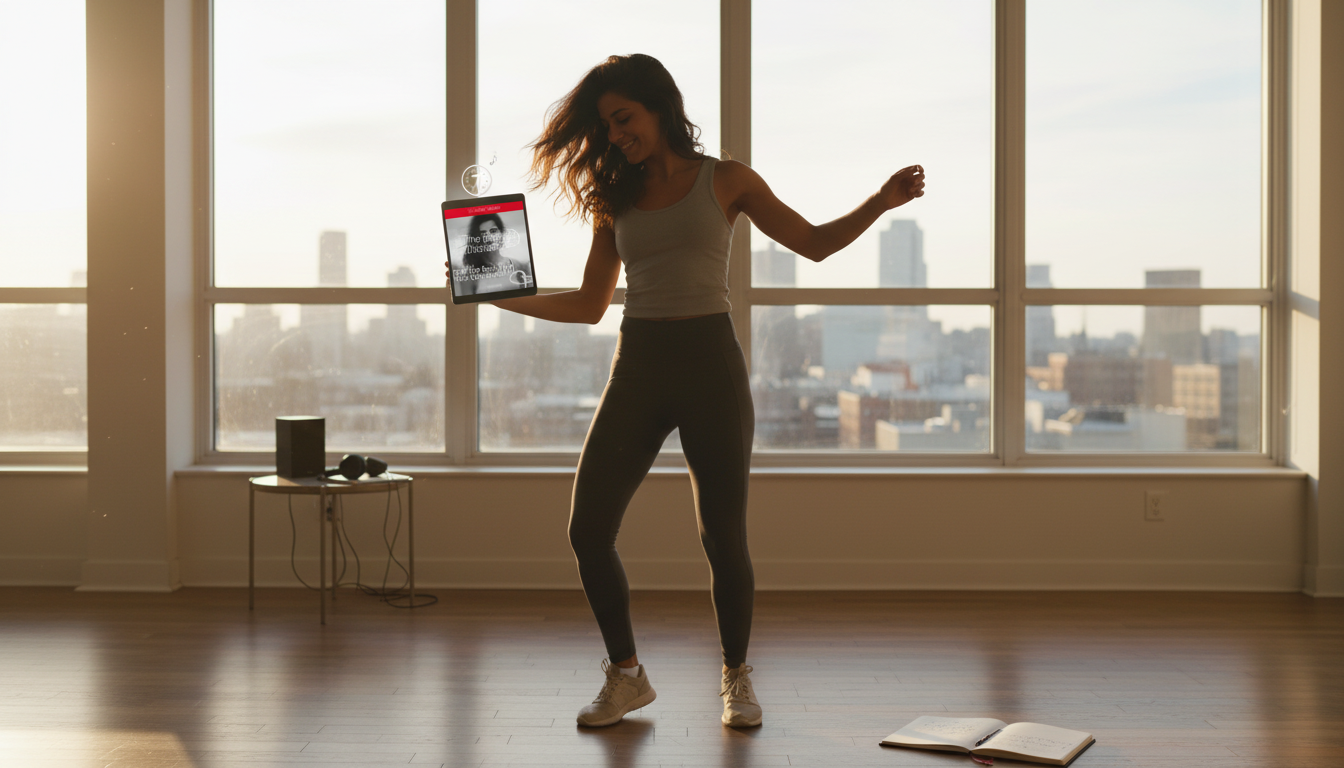
Dancing can feel oddly high-stakes for something that’s supposed to be fun. The moment a mirror is involved, a crowd forms, or a camera pops up, self-consciousness tends to spike—especially when experienced dancers are nearby. It’s not a character flaw; it’s a normal stress response when attention feels “on.”
Another common trap is mixing up “I don’t know steps yet” with “I have no rhythm.” Steps are information. Rhythm is a skill—and skills can be trained quickly with simple repetition. When fear of looking awkward kicks in, the body often tightens up. That stiffness makes movement feel worse, which reinforces the fear. The fastest way out is shifting the goal from “look good” to “stay present and keep moving.”
Dance confidence isn’t a personality type; it’s a set of learnable behaviors that make it easier to move in real time.
This is closely tied to self-efficacy—your belief that you can do a task—because confidence rises when you collect small, repeated wins. (See the APA definition of self-efficacy.)
Beginners often try to “think” their way into confidence. A better approach is to give the nervous system clear, simple signals that you’re safe enough to move.
That routine matters because it reduces decision fatigue. When you already know how to start, you’re less likely to freeze.
Rhythm gets easier when you build it from the inside out—pulse first, variation second.
It can also help to practice to songs with a clear tempo and predictable structure. Once your body trusts it can “find home” on the beat, everything else feels less scary.
Short sessions lower resistance and keep practice emotionally “safe.” Stick to one or two songs a day and repeat the same track so progress becomes obvious. If recording tends to trigger self-critique, save it for the final two days and keep it to 15 seconds—just enough to notice improvement.
| Day | Focus | 10-minute drill | Confidence cue |
|---|---|---|---|
| 1 | Find the pulse | Foot tap + gentle bounce on 1-2-3-4 for one full song | Keep moving even if it feels basic |
| 2 | Loosen tension | Shoulder rolls + sway side-to-side on the beat | Soft knees, relaxed jaw |
| 3 | Step-tap reset | Step-tap right/left on counts 1-2-3-4, then add arms | When lost, return to step-tap |
| 4 | Directional movement | Two steps forward, two back; then side-to-side, all on beat | Small steps count as steps |
| 5 | Add one “signature” move | Choose one simple move (hip sway, body roll, clap) and repeat in rhythm | Repetition creates comfort |
| 6 | Freestyle without stopping | 60 seconds continuous movement; repeat 3 times with breaks | No pauses—only resets |
| 7 | Real-world practice | Dance to one song as if at a party: bounce + step-tap + signature move | Confidence = staying present |
As your comfort grows, dancing becomes an easy way to get more daily movement, which supports mood and energy over time. (More on general benefits here: NHS — Exercise: Benefits.)
Use micro-sessions (3–10 minutes) and a repeatable default pattern like bounce + step-tap. Focus on staying in motion rather than looking polished, and consider removing mirrors at first so you feel less “watched.”
Rhythm is learnable: start by matching a steady pulse, count 1–4, and use a gentle bounce to feel the beat in your body. Repeating the same track for a few days builds timing faster than constantly switching songs.
After purchase, you typically get quick access through a download link and can read the file on a phone, tablet, or laptop. Save a backup copy, and if an email link is involved, check your spam or promotions folder.





Leave a comment