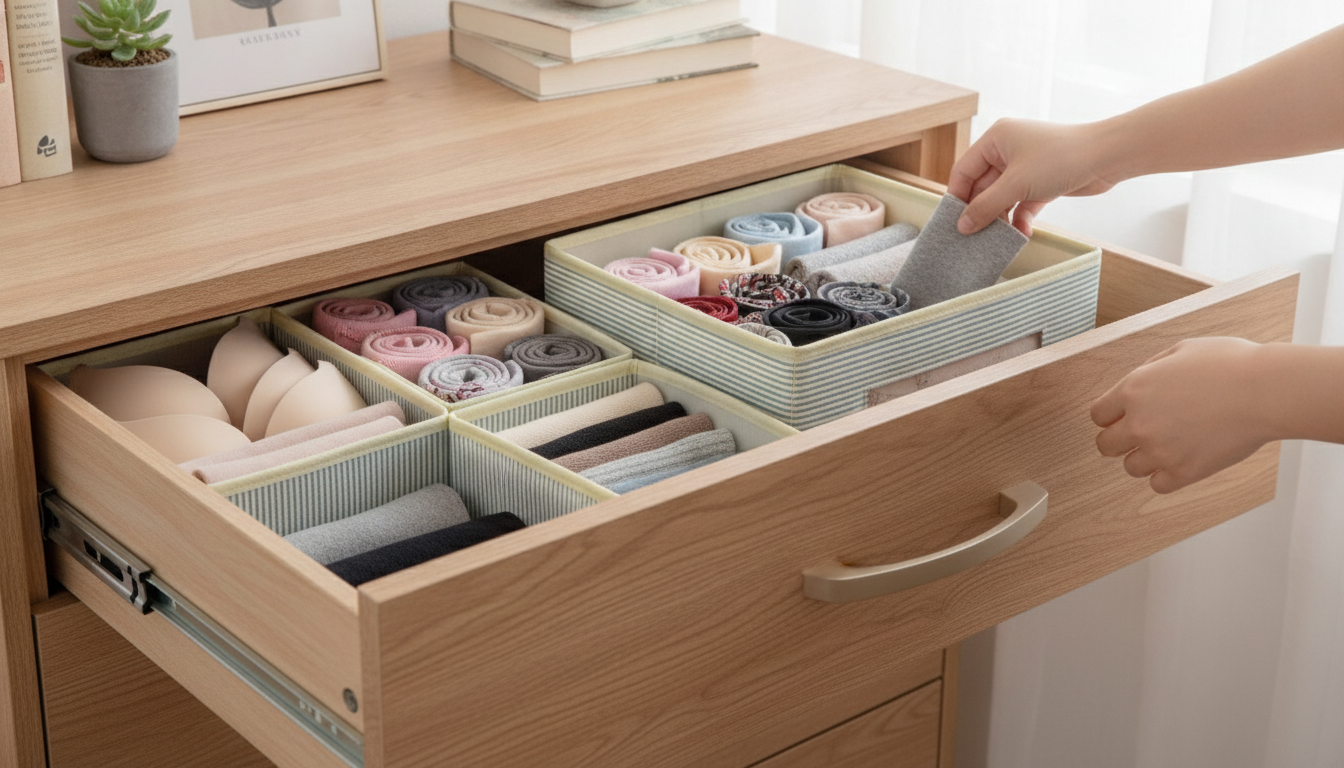
Loose piles and half-folded items make drawers feel crowded even when there’s plenty of space. A compartment-style organizer turns one deep drawer into easy-to-scan zones for underwear, socks, scarves, and ties, so getting dressed is faster and putting laundry away takes less effort. Instead of re-folding the same stack every time you pull one item, you’ll see what you have, grab what you need, and keep everything in place with minimal maintenance. For more guidance, see how to organize small spaces: 110+ Hacks – Minimize My Mess.
Why drawers get messy so quickly
- Small items shift when a drawer opens and closes, causing stacks to collapse and mix together.
- Different item sizes (ankle socks vs. crew socks, briefs vs. bras, skinny ties vs. wide ties) make uniform stacks impractical.
- “Temporary” toss-in habits accumulate: one rushed morning can undo a neat fold.
- A fixed home for each category reduces decision fatigue and prevents overflow.
What a multipurpose drawer organizer changes day to day
- Creates visible boundaries so each item type stays in its lane instead of migrating across the drawer.
- Makes outfit building faster: items are easy to compare at a glance without digging.
- Prevents overstuffing by showing when a section is full—an instant cue to declutter or relocate.
- Supports simple routines: sort laundry directly into compartments rather than building piles.
If you’ve ever bought “more socks” because you couldn’t find the matching pair, compartments also make duplicates obvious. When everything has a spot, it’s easier to see what you truly use and what’s quietly taking up space. For further reading, see Capturing Chinook salmon fry for foraging experiments.
Setting up a drawer in 10 minutes
- Empty the drawer completely and wipe it down; remove lint so fabric pieces don’t snag.
- Group items by type first (underwear, socks, scarves, ties), then by sub-type (work socks vs. sport socks; everyday underwear vs. special-occasion).
- Place the organizer so the most-used sections are closest to the front edge for quick access.
- Fold or roll consistently within each compartment; keep one spare slot for “in-between” items to avoid overflow piles.
- Do a quick capacity check: if one category overflows, reduce duplicates or move seasonal pieces elsewhere.
For folding inspiration, the KonMari folding method shows how upright folding keeps items visible and easy to pull without disturbing the rest. For broader dresser-drawer tips, The Spruce has practical guidance on sorting and maintaining categories.
Folding and storing by category
Underwear
- Fold into compact rectangles so each piece stands upright; keep similar styles together for easy grabbing.
- Use one compartment for everyday favorites and another for backups or special-occasion pieces to reduce rummaging.
Socks
- Pair and fold flat or roll lightly; avoid tight rolls that stretch elastic over time.
- Keep athletic socks separated from dress socks so you don’t have to sort at 7 a.m.
Scarves
- Fold into thirds, then into a compact bundle; delicate fabrics should sit loosely to reduce creasing.
- Place textured knits away from silk or fine weaves to minimize snagging when you pull items out.
Ties
- Lay flat and fold once or twice depending on compartment size; keep silk ties separated from rough textures to prevent snags.
- Group by use (workday neutrals vs. formal/event ties) so the “right” option is always in the same spot.
Drawer layout ideas for different spaces
- Single-drawer capsule: allocate the front row to daily socks and underwear, back row to scarves/ties used less often.
- Two-drawer split: dedicate one drawer to underwear and socks, another to accessories; keep formal items together.
- Shared drawer strategy: assign sections per person rather than per item type to prevent mixing in shared spaces.
- Seasonal rotation: store warm scarves and thicker socks in off-season bins and free up prime drawer real estate.
Quick layout guide by drawer type
| Drawer type |
Best compartment focus |
Practical tip |
| Shallow dresser drawer |
More sections for socks and underwear |
Use upright folding so each piece is visible without stacking |
| Deep dresser drawer |
Mixed sections for underwear, socks, scarves, ties |
Place the organizer toward the front and store bulkier items behind it |
| Closet built-in drawer |
Accessory-heavy setup (ties/scarves) |
Keep formal accessories closest to the front for weekday routines |
| Kids’ drawer |
Simple sock/underwear zones |
Use fewer categories so cleanup stays easy |
Keeping it tidy with minimal effort
Multipurpose Drawer Organizer for Underwear, Socks, Scarves & Ties (In stock, $29.80)
More in-stock picks
FAQ
Will a drawer organizer work in deep drawers without wasting space?
Yes. Place the organizer at the front for everyday underwear and socks, then use the open space behind it for bulkier or less-used items; the compartments also prevent small items from sliding around in deeper drawers.
How should socks be stored to avoid stretching the elastic?
Store socks with a light fold or a gentle roll and avoid tight “balling,” which puts constant tension on the elastic. Keeping pairs together in one compartment also prevents mismatches without over-handling.
What’s the easiest way to keep scarves and ties from wrinkling in a drawer?
Fold them loosely, avoid overfilling compartments, and separate delicate fabrics from rough textures to reduce snags. Reserving a dedicated section for formal accessories also cuts down on rummaging that causes wrinkles.
Recommended for you





Leave a comment