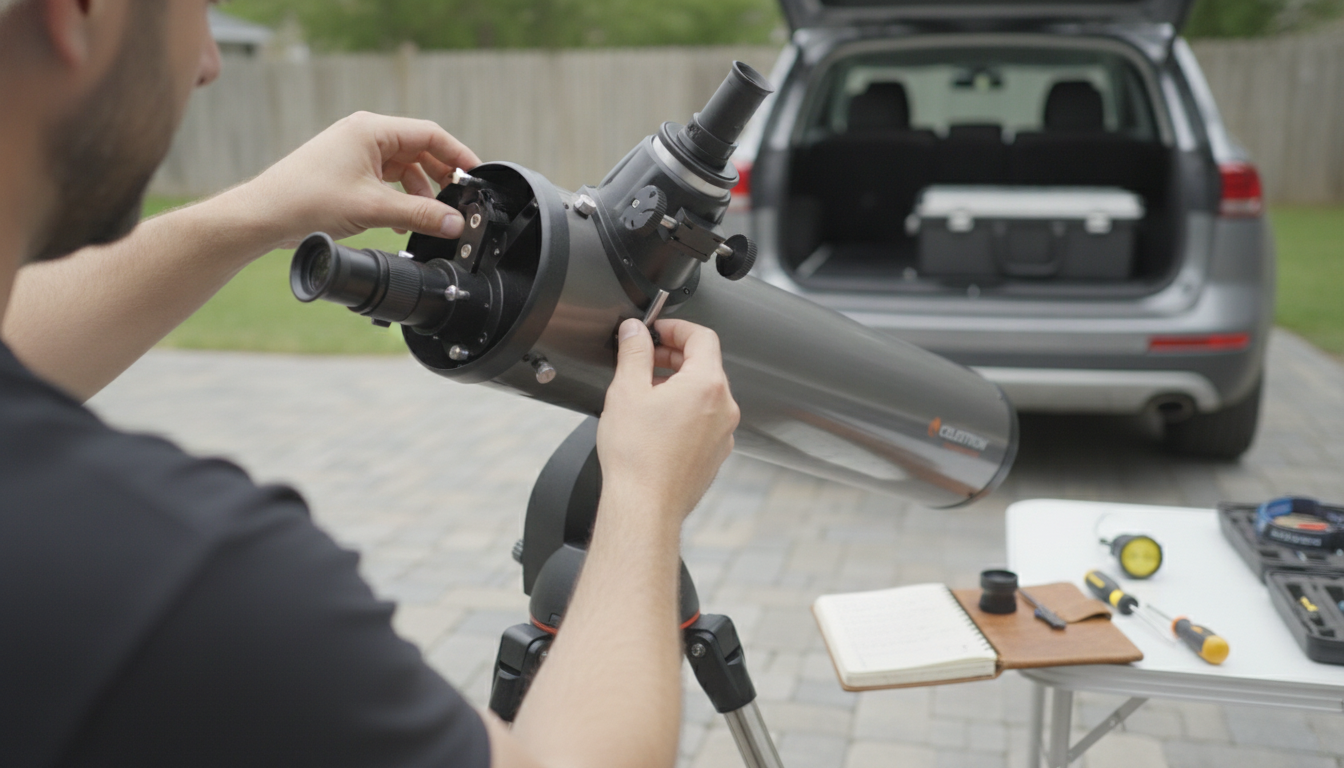
Setting up a Newtonian reflector is mostly about getting the mount stable, balancing the tube, aligning the finder, and—if needed—collimating the mirrors. Take it step by step and you’ll be ready for your first targets without fighting shaky views or misalignment.
Place the tripod or base on firm ground and level it as well as possible to reduce drift and vibration. Tighten all leg clamps and accessory tray/spreader hardware. If you’re using an equatorial mount, set the latitude/tilt roughly for your location; for an alt-az mount, ensure the altitude and azimuth axes move smoothly without wobble.
With the mount locked, seat the Newtonian tube into its rings or dovetail saddle. Tighten the ring clamps and saddle bolts firmly—snug, not forced. Point the tube horizontal while securing it to prevent it from swinging unexpectedly.
Insert the focuser adapter (if needed), then the eyepiece. Start with a low-power eyepiece (longer focal length, often 20–32mm) because it gives a wider view and makes finding objects easier. Attach the finder scope or red-dot finder and confirm its bracket is fully seated.
Unlock one axis at a time and check whether the tube wants to nose-dive or swing. Slide the tube in the rings (or shift the dovetail position) until it stays put when lightly released. If your mount uses counterweights, adjust the counterweight position until the system is neutral and tracks smoothly.
In daylight, aim the main telescope at a distant stationary object (like a utility pole insulator) using the low-power eyepiece. Center it, then adjust the finder’s alignment screws until the finder points at the same object. This saves a lot of frustration after dark.
Newtonians often need occasional collimation (mirror alignment). If stars look like comets or you can’t reach sharp focus, use a collimation cap or laser to center the secondary and primary mirror reflections. Small tweaks usually make a big difference.
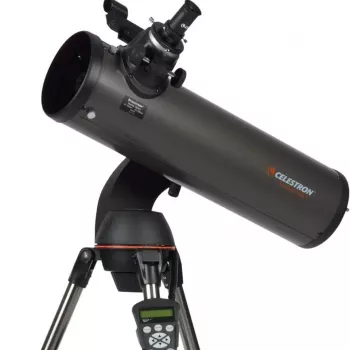
For a guided walk-through that includes setup tips for a compact computerized Newtonian with SkyAlign, see this setup guide.
Use a simple collimation cap (or a well-centered peep hole) to align the secondary under the focuser, then adjust the primary mirror knobs until the primary’s center mark is centered in the cap view. Finish with a quick star test at medium power to confirm sharp, symmetrical diffraction rings.





Leave a comment