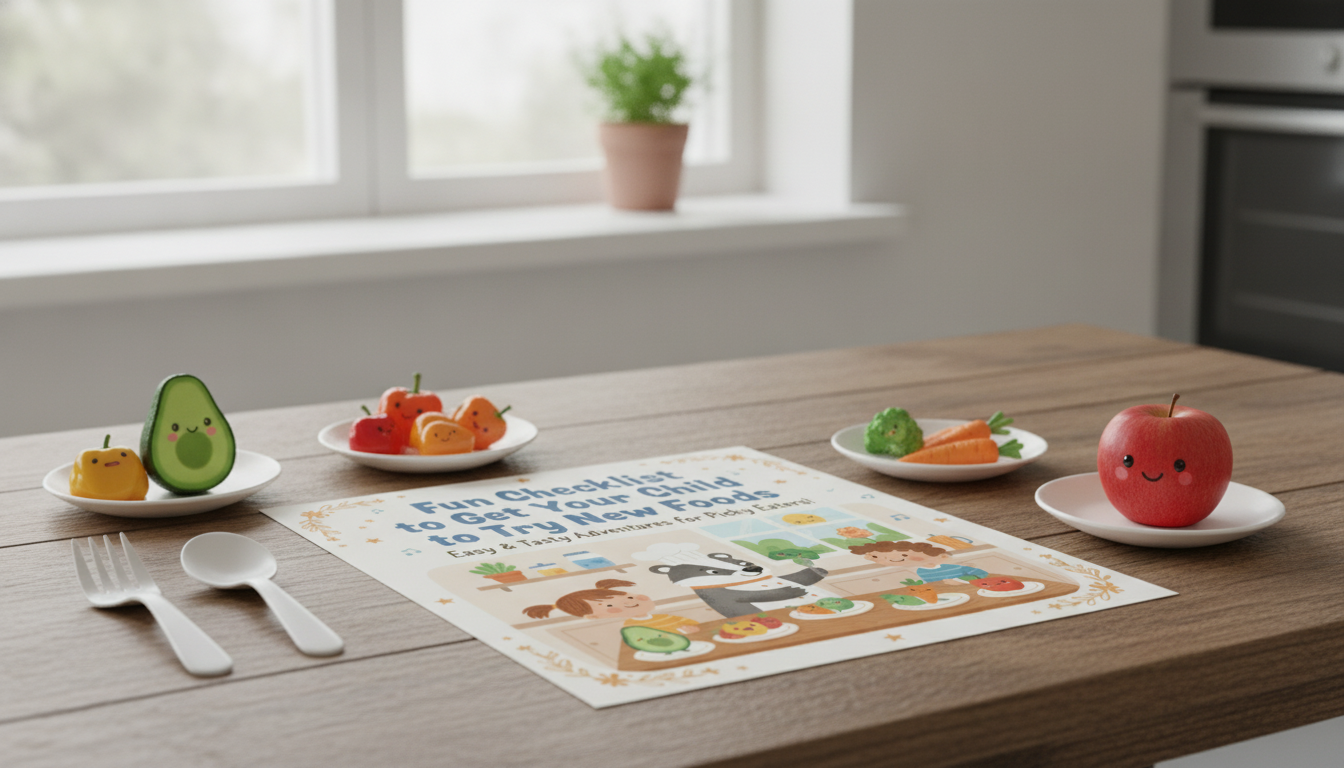
New foods can feel unpredictable for kids, which is why pressure often backfires at the table. A simple, playful checklist turns tasting into a low-stakes routine: small steps, clear expectations, and plenty of choice. Use the ideas below to reduce mealtime tension, build curiosity, and help children practice trying foods at their own pace—then print a guide to keep the momentum going.
Food refusal is rarely about “being difficult.” Many children go through food neophobia—hesitation around unfamiliar foods—and it commonly peaks during the preschool years. A child may reject a food because of smell, texture, temperature, color, or even how it touches other foods. Those preferences are often sensory, not behavioral.
Timing also matters. Overtired or over-hungry kids tend to be less flexible, while constant snacking can make dinner feel optional. And although it’s tempting to bargain (“Just one bite!”), pressure can raise anxiety and reduce acceptance over time. Repeated, neutral exposure works better: seeing a food often, in a calm setting, helps it become familiar even before tasting happens.
Instead of making the goal “eat it,” shift it to “practice.” Practice can look like: look, smell, touch, lick, nibble, and eventually take a bite.
| What you notice | What it might mean | A helpful next step |
|---|---|---|
| “No, I hate it” before tasting | Unfamiliarity or anxiety about surprise flavors | Offer a tiny “learning bite” next to a safe food; describe it neutrally (crunchy, sweet, warm) |
| Gags on mixed textures (soups, casseroles) | Texture sensitivity or difficulty with combinations | Serve components separately; let the child mix a small portion if they choose |
| Only eats one brand/shape | Predictability feels safe | Keep the preferred version available while offering a “neighbor” version (different brand/shape) for exploration |
| Pushes food away if it touches others | Sensory boundaries around food contact | Use a divided plate or small cups; allow “no touching” as a temporary rule |
| Refuses when pressured | Autonomy is being challenged | Use choice language: “Do you want to smell it or touch it first?” |
| Tries at school but not at home (or vice versa) | Context and stress levels differ | Recreate the successful context: same dip, same plate, calm timing, fewer comments |
A calm setup does more than any script. The goal is to make experimenting feel safe and predictable—even if the food is new.
For more on supportive feeding structure, the Division of Responsibility model is a helpful framework: the adult decides what and when, the child decides whether and how much. See details from the Ellyn Satter Institute.
Kids are more willing to participate when “trying” is broken into steps. A checklist makes success visible, even when the child doesn’t take a full bite.
Turn tasting into a game with a ladder of options. Each step is a win:
Acceptance often takes many exposures. That means offering the same “learning food” across weeks, not giving up after one refusal. The American Academy of Pediatrics also emphasizes patience and repeated exposure for picky eaters: HealthyChildren.org.
Track patterns gently: time of day, hunger level, who’s at the table, and which textures are easiest. These clues help you pick better “next foods.” For additional ideas on introducing new foods in low-pressure ways, the NHS shares practical tips: Avoiding picky eating: tips for introducing new foods.
If you want a ready-to-print version with tasting steps, prompts, and simple tracking, use the internal guide here: Printable checklist and kids mealtime guide.
For educators and caregivers who also want a structured way to build consistent routines, this digital download can help with planning and follow-through: Aim High, Teach Bold: A Practical Guide to Goal Setting for Teachers & Educators.
It often takes many exposures, especially for foods with new textures or strong smells. Keep offering the food in tiny portions and treat interaction (looking, smelling, touching) as progress.
Requiring bites can increase anxiety and resistance over time. Instead, offer choices like “smell, touch, lick, or nibble” and keep the routine calm and predictable.
Start with small “bridge foods,” keep at least one safe food available, and use tiny portions to reduce pressure. If the accepted list is shrinking quickly or meals are consistently distressing, consider professional guidance.






Leave a comment