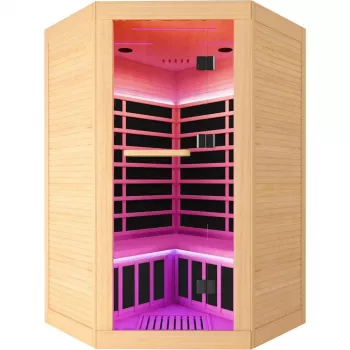
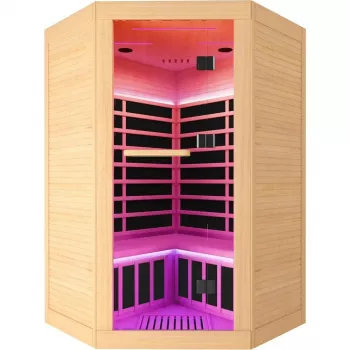
A corner infrared sauna is designed to deliver full-body warmth while using a footprint that fits neatly into underused room angles. For households that want a shared sauna experience without dedicating an entire wall to a cabin, a 2–3 person corner layout balances comfort, seating flexibility, and efficient placement in bedrooms, gyms, and wellness rooms.
A corner configuration places the cabin diagonally, turning a hard-to-use corner into a practical wellness zone. That diagonal front often improves the feel of the interior because the usable space spreads outward instead of “boxing in” the seating area.
The 2–3 person size is a sweet spot for couples who want breathing room, a parent and teen who share sessions, or solo users who like to recline, stretch, or sit cross-legged without bumping elbows. It’s also a strong fit for home gyms, finished basements, larger bathrooms, and multipurpose wellness rooms where preserving traffic flow matters.
Infrared heat warms the body more directly than traditional hot-air heating, and many users find it comfortable at lower cabin temperatures than a classic sauna. For a helpful overview of benefits and cautions, see guidance from Cleveland Clinic and Mayo Clinic.
Most homes have corners that collect unused furniture or become dead space. A corner sauna reclaims that square footage while leaving long walls available for mirrors, storage, a treadmill, a bench, or a TV viewing angle.
The diagonal entry can also make planning easier. Instead of pushing a rectangular cabin flat against a wall (and then fighting for door swing clearance), the door can face outward into open room space. Visually, a corner cabin often feels more integrated with the room geometry—less like a large box “stuck” on a feature wall.
Corner placement is especially helpful in rooms with windows, baseboard heaters, built-ins, or closet doors where uninterrupted wall runs are limited.
| Consideration | What to check | Why it matters |
|---|---|---|
| Flooring | Level, stable, and moisture-tolerant surface | Helps the door align properly and supports long-term stability |
| Clearance | Door swing and walking path around the entry | Reduces daily friction and improves safety when stepping out warm |
| Ventilation | Normal room airflow; avoid tight closets | Supports comfort and helps manage humidity after sessions |
| Power | Outlet location and circuit capacity | Prevents extension-cord workarounds and nuisance trips |
| Moisture zones | Distance from showers, tubs, or splashing | Protects electronics and wood surfaces |
In day-to-day use, two adults typically sit comfortably with personal space. A third person can fit, but it’s usually best for shorter sessions, smaller body frames, or “rotating” posture (for example, one person sits slightly angled while another leans back). If three adults plan to use the sauna frequently at the same time, comfort depends heavily on bench length, seat depth, and how upright the backrest keeps shoulders.
Corner designs can feel surprisingly open at knee and leg level. Because the front edge widens diagonally, the cabin may offer extra room where it counts: feet placement, shifting positions, and not feeling pressed against a flat front panel.
A practical way to gauge real comfort is to picture the session essentials: two towels per person (one to sit on, one to wipe off), a water bottle nearby, and enough shoulder room to breathe deeply without contact. If it feels “fine” when empty but cramped once you add towels and arm movement, it may be a two-person routine with occasional third-person flexibility.
Many people enjoy infrared sessions in moderate heat ranges, especially if they dislike the intense air heat of traditional saunas. Warm-up time varies based on room temperature, insulation, and unit power, so building a consistent routine usually includes a short preheat period.
If the goal is shared heat therapy without giving up a long wall, the 2-3 Person Corner Infrared Sauna is built around that exact constraint: a corner footprint that uses room angles efficiently while providing comfortable seating for two and flexible capacity for three. It’s a strong match for home wellness spaces where maintaining room flow is as important as the sauna itself.
| Item | Details |
|---|---|
| Name | 2-3 Person Corner Infrared Sauna |
| Price | 5529.49 USD |
| Availability | In stock |
Many sauna owners build sessions into a broader recovery rhythm—movement, hydration, and protein-forward meals. If you like having a quick reference on hand, the High-Protein Ideas for Muscle Recovery Checklist | Digital Download is an easy way to keep post-workout nutrition ideas organized alongside your wellness routine.
Two adults typically have comfortable personal space for regular sessions. Three can work when one person is smaller or when sessions are shorter, but comfort depends on bench length, shoulder room, and how much everyone shifts positions during heat-up.
A common beginner range is 10–20 minutes, then gradually increasing as you learn what feels comfortable. Hydrate before and after, and plan a short cool-down outside the cabin instead of rushing into extreme temperatures.
Yes, as long as the floor is level, you have adequate door swing clearance, and the room has normal airflow (avoid tight closets). Measure the corner carefully, keep the unit away from splash zones, and confirm outlet location and circuit capacity before setup.




Leave a comment