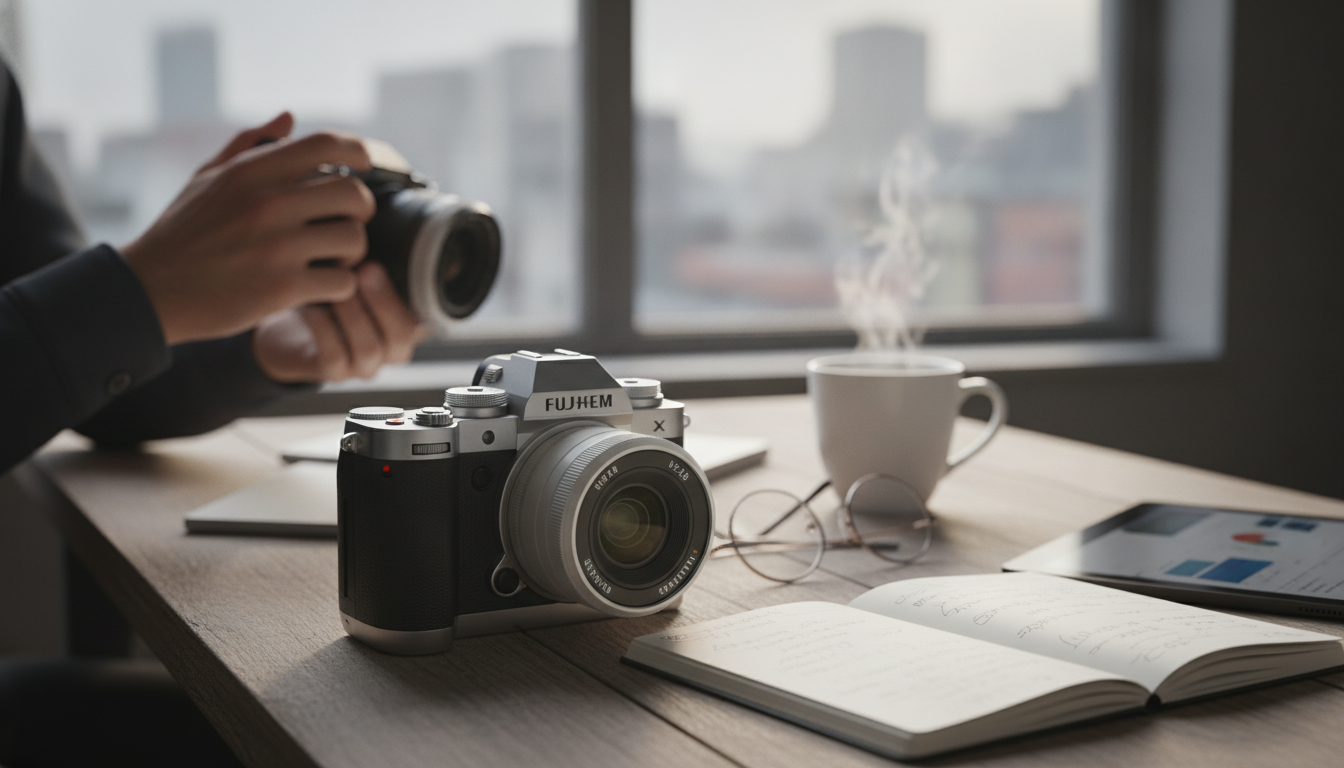
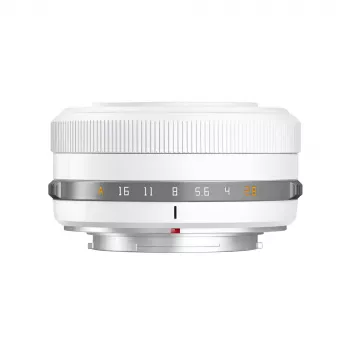
A compact autofocus prime can be one of the simplest ways to keep a Fujifilm X-Mount kit light while still getting consistent results for everyday photography. A 1.06 in (about 27mm) f/2.8 AF lens typically lands in the “always-on” category: small enough to carry daily, wide enough for most situations, and straightforward to operate when moments move quickly. For more guidance, see Viltrox AF 90mm f/2.2 EVO: Perfect for Portraits – Ricks Reviews.
If you’re considering adding one to your bag, start with the basics—fit, field of view, and autofocus behavior—then dial in a few settings for the way you actually shoot. For further reading, see Fujifilm X-mount – Wikipedia.
If you’re shopping for this type of lens, see the current listing here: 1.06 in f/2.8 AF Lens for Fujifilm X-Mount Cameras.
On Fujifilm APS-C bodies, a ~27mm lens generally delivers a natural perspective—close to what many people call a “normal” view. It’s a comfortable middle ground: not so wide that straight lines bend dramatically at the edges, and not so tight that you constantly have to back up indoors. For a deeper explanation of how focal length relates to angle of view, Cambridge in Colour is a solid reference: Understanding focal length and angle of view.
f/2.8 is a practical balancing point in many small primes: bright enough for a lot of indoor scenarios, yet compact enough to keep the camera nimble. Depth of field at this focal length can blur backgrounds nicely, but it’s very distance-dependent. If the subject is close and the background is far, separation is more noticeable; if everything is far away, the scene will look more uniformly sharp.
For a quick refresher on depth of field behavior, Nikon’s overview explains the core variables clearly: Depth of field basics.
Autofocus on Fujifilm X bodies is often excellent, but third-party lenses can vary depending on camera model and firmware. Before counting on AF for important moments, do a short real-world test: close focus, mid-distance, backlit scenes, and basic subject movement.
For general system information and body support, Fujifilm’s official overview is the most reliable starting point: FUJIFILM X Series Cameras.
| Item to verify | Why it matters | How to confirm |
|---|---|---|
| Fujifilm X-Mount fit | Ensures correct mechanical and electronic connection | Confirm the product listing and mount marking on the lens |
| Autofocus support on your body | Determines reliability for people, pets, and video | Test AF-S/AF-C and face/eye detection after mounting |
| Aperture control | Affects speed of shooting and exposure workflow | Check for an aperture ring or camera-dial control behavior |
| Filter compatibility | Enables ND/CPL/diffusion for stills and video | Check filter thread size and whether a hood blocks filter rotation |
| Firmware update path | May improve compatibility and performance | Look for manufacturer update instructions or support pages |
It should physically mount on Fujifilm X-Mount bodies, but autofocus and full electronic features can vary by camera model and lens firmware. After mounting, test AF-S/AF-C, aperture control, and video behavior to confirm everything works as expected.
f/2.8 helps a lot, but shutter speed and subject motion still matter more than the aperture alone. Using Auto ISO with a minimum shutter speed is a reliable approach, and stabilization or a tripod can help for static scenes.
It’s an all-around focal length that excels at street and travel, and it works well for environmental portraits where you want context. Landscapes can look great when stopped down for edge-to-edge sharpness, while tight portraits are usually better with a longer lens to avoid perspective exaggeration.




Leave a comment