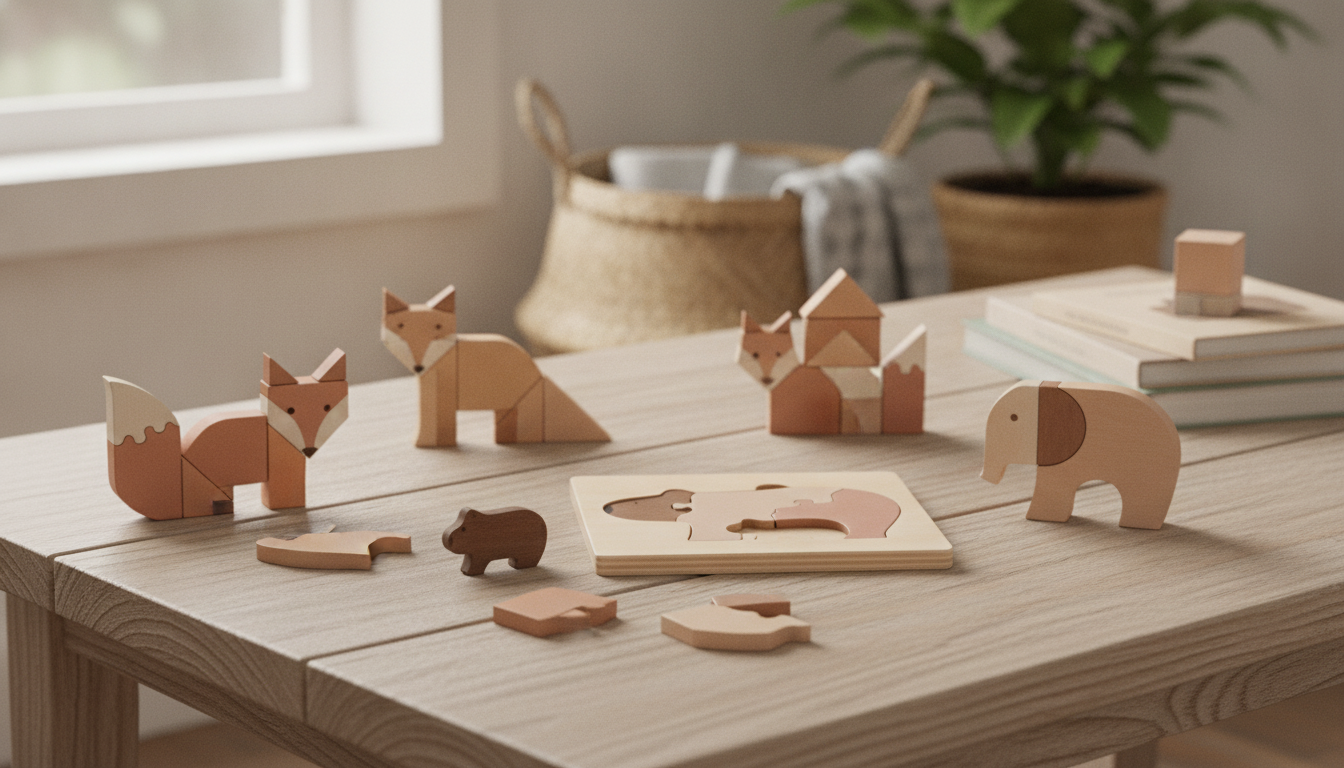
A wooden tangram puzzle set with cheerful cartoon animals turns “learning time” into hands-on play. Kids can match shapes to make familiar animals, experiment with 3D-like arrangements, and invent their own creatures—all while practicing fine motor control, spatial reasoning, and early logic. This style of open-ended puzzle fits naturally with Montessori-inspired learning: children explore, test ideas, and self-correct as pieces click into place.
The Wooden Montessori 3D Cartoon Animal Puzzles Tangram uses tangram-style pieces designed to assemble into animal-themed pictures and playful, layered builds that feel “3D” as kids stack, rotate, and re-orient shapes. Instead of one fixed end result, children can move from copying a model to creating brand-new arrangements—keeping the activity fresh long after the first successful solve.
Because the “answer” isn’t always just one picture, kids often return to tangrams the way they return to blocks: to build, rebuild, and try a new idea. That’s also what makes it a strong choice for calm, screen-free downtime—before dinner, during quiet time, or as a travel-friendly tabletop activity.
Hands-on puzzles help children build foundational abilities that show up in everyday tasks—buttoning a shirt, holding a pencil, describing where something is, or figuring out how parts fit together. Montessori education emphasizes learning through concrete materials and self-directed repetition (see Britannica’s overview of the Montessori Method), which aligns well with tangram-style play.
| Skill area | What kids do | Easy prompt to try |
|---|---|---|
| Fine motor skills | Pinch and place pieces accurately | “Can you line up the corners so they touch?” |
| Spatial reasoning | Rotate pieces to match outlines | “Try turning it a quarter turn.” |
| Problem-solving | Test multiple combinations | “What could you swap to make it fit?” |
| Early math | Compare shapes and sizes | “Which piece is the biggest triangle?” |
| Language | Describe animals and scenes | “Tell a story about your animal.” |
For families wondering what “fine motor skills” include and why they matter, the overview from MedlinePlus on fine motor skills is a helpful reference. Even short puzzle sessions can support the hand strength and control children use in drawing, writing, and self-care routines.
This kind of puzzle scales naturally with development. The same pieces can be used for sensory exploration, matching, structured challenges, and creative design—depending on the child’s age and interest that day.
If a child gets stuck, try “less help, more hints.” Instead of placing the piece for them, offer a directional cue (“flip it over,” “rotate it,” “try a different corner”) and let them do the final move. That moment of self-correction is where a lot of confidence is built.
Open-ended puzzles shine when you turn them into mini-games. Rotating through a few simple formats keeps interest high while still reinforcing the same underlying skills.
For a fun “whole household” twist, some families pair kids’ puzzle time with a calm enrichment activity for pets—especially if a dog wants to be included in the routine. A separate, pet-safe option like the Dog Training Toy can help keep focus on both sides: kids build at the table while a dog works on a supervised challenge nearby.
As children grow, their reasoning about shapes, rules, and strategies becomes more flexible. For a deeper perspective on how children’s thinking develops over time, the Stanford Encyclopedia of Philosophy entry on cognitive development offers a broad, research-informed overview.
Many families start with supervised exploration around toddler age and continue through early elementary years. Difficulty scales easily: toddlers can sort and match, preschoolers can copy simple models, and older kids can design original animals or solve timed challenges.
It encourages child-led exploration with hands-on materials, and kids can self-correct by testing whether pieces truly fit. Repeating builds builds concentration, independence, and confidence without requiring constant adult direction.
Wipe pieces with a slightly damp cloth, then dry fully; avoid soaking to prevent warping. Store pieces together in a tray, pouch, or box so parts don’t get lost and kids can return to an unfinished build later.





Leave a comment