Fuel Your Fire: Motivation Strategies for the Hard Stuff
Difficult tasks often stall not because of a lack of ability, but because the brain resists discomfort, uncertainty, and delayed rewards. A practical motivation plan makes tough work feel smaller, clearer, and easier to start—especially on low-energy days. The most reliable approach is simple: reduce friction, create quick wins, protect focus, and build follow-through routines that don’t depend on mood.
Why difficult tasks feel impossible to start
“I’ll do it later” usually isn’t laziness—it’s a predictable response to pressure and ambiguity. Procrastination is commonly defined as delaying an intended task despite expecting to be worse off for the delay (see the APA Dictionary of Psychology). A few patterns show up again and again:
- Emotional friction: dread, boredom, fear of failure, or even fear of success can trigger avoidance.
- Cognitive overload: unclear next steps and too many options raise the mental cost of beginning.
- Reward delay: when payoff is far away, the brain prefers immediate relief (scrolling, snacking, “just one more” small task).
- Perfection pressure: aiming for an ideal outcome makes the first draft feel risky, so starting gets postponed.
- Energy mismatch: demanding work scheduled at low-energy times increases procrastination, even with strong intentions.
A simple “ignite sequence” to start in 5 minutes
If starting is the hardest part, treat “start” like a skill. This ignition sequence is designed to create motion first, motivation second.
- Name the task in one sentence, then define “done for today” as a small deliverable (one page, one email draft, 10 minutes of practice).
- Shrink the entry point: pick a first step that is physically easy—open the file, set a timer, lay out materials.
- Set a short sprint (5–15 minutes): the goal is to begin, not to finish.
- Use a start ritual: same music, drink, desk setup, or breathing pattern to signal “work mode.”
- End with a breadcrumb: write the next step before stopping so tomorrow’s start is frictionless.
This pairs well with “tiny” behavior design ideas—start small enough that you can’t talk yourself out of it (see Stanford’s Tiny Habits approach).
Turn procrastination into information
Instead of treating procrastination like a character flaw, treat it like a dashboard warning light. The delay is pointing to a missing piece: clarity, energy, safety, or meaning.
- Identify the type: avoidance (fear), confusion (unclear), depletion (tired), or rebellion (resentment).
- Match the fix: fear needs smaller stakes; confusion needs a checklist; depletion needs rest or a lighter sprint; rebellion needs meaning or choice.
- Swap the question: replace “What’s wrong with me?” with “What is this task demanding that I haven’t prepared for yet?”
- Use a 2-minute clarification: write the goal, constraints, deadline, and the very next action.
Procrastination pattern → quick adjustment
Procrastination pattern → quick adjustment
| Pattern |
Common signal |
Fast reset |
First step example |
| Fear of failing |
Stalling on high-visibility work |
Make it a draft-only sprint |
Write a messy outline with 5 bullet points |
| Unclear next step |
Busywork replaces progress |
Define one concrete deliverable |
Create a checklist of 3 actions |
| Low energy |
Everything feels heavy |
Reduce scope + shorter timer |
Work for 10 minutes, then stop |
| Perfectionism |
Endless planning/research |
Set a “version 1” deadline |
Create the simplest acceptable draft |
| No meaning |
Resentment and delay |
Connect to a value or reward |
Pick one part you control and start there |
Motivation that survives bad moods: design the environment
Willpower is a finite resource. Environment is a system that keeps working when you don’t feel like it.
- Lower friction: keep tools visible, logins saved, templates ready, and work materials in one place.
- Raise the cost of distraction: full-screen mode, app blockers, phone in another room, or a separate user profile for work.
- Use default decisions: pre-decide when, where, and how long the task will happen to reduce daily negotiation. (This aligns with implementation intentions: deciding “if X, then I do Y.” See James Clear’s overview.)
- Create a minimum viable session: a tiny version of the task that counts as a win even on rough days.
Build momentum with quick wins and tracking
Hard work becomes easier when progress is visible and rewards are immediate.
- Score progress by sessions completed, not by perfection of results; consistency is the multiplier.
- Use visual proof: a simple habit tracker, calendar chain, or checklist makes effort feel real.
- Reward completion immediately: pair the end of a session with a small, healthy payoff (walk, tea, short break) to train follow-through.
- Run a weekly review: note what triggered resistance, what helped, and one change to try next week.
When the task is emotionally heavy
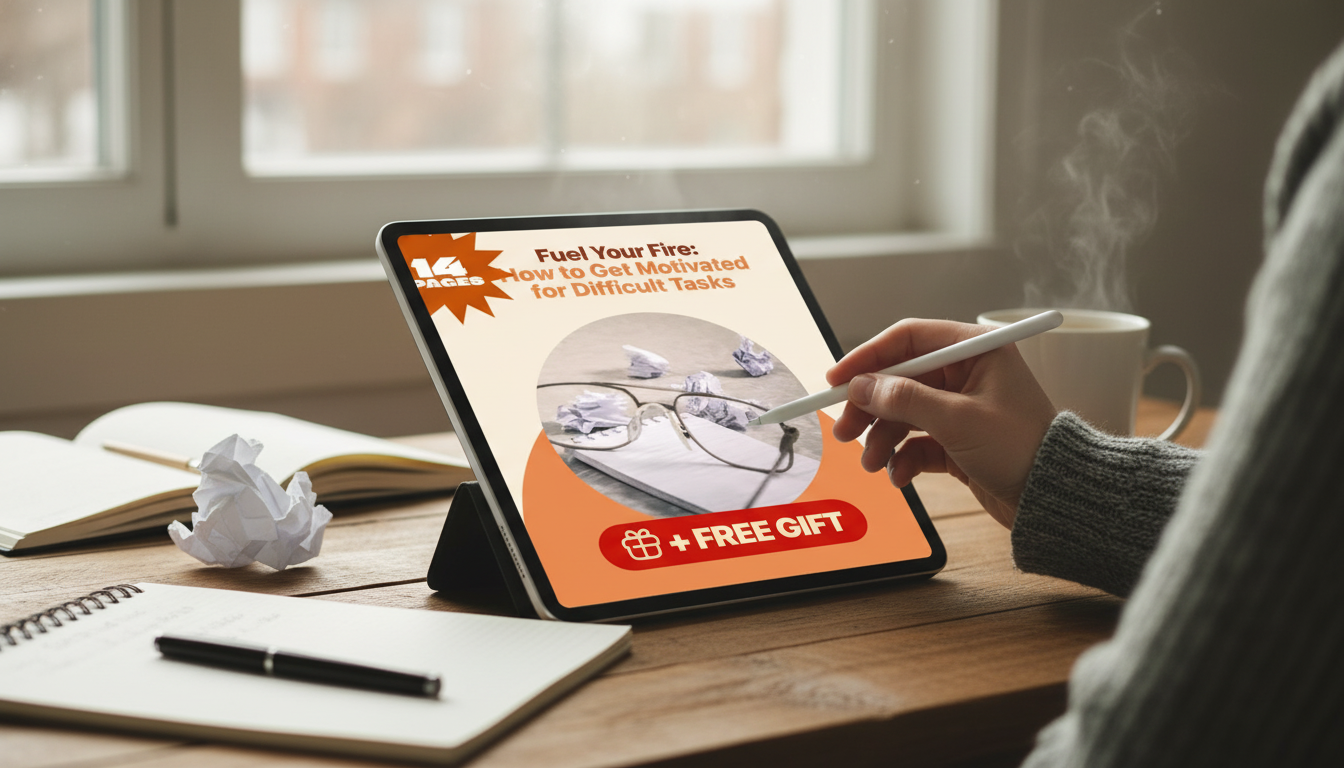
A practical digital guide for follow-through
FAQ
What if motivation never shows up and the deadline is close?
Go action-first: start with a 5-minute sprint, define “done for today” as a small deliverable, and reduce scope until forward motion is possible. Motivation often shows up after movement begins.
How long should a work sprint be for difficult tasks?
Start with 10–25 minutes, then take a short break and repeat if energy allows. End each sprint by writing the next step so the next session starts faster.
How can procrastination be reduced without relying on willpower?
Design the environment: remove friction (tools ready), block distractions, set default schedules, and track sessions instead of waiting for the “right mood.” Systems are more dependable than motivation.
Recommended for you






Leave a comment