Managing Two Kids on Different Schedules: A Practical Guide for Busy Families
Two children can mean two rhythms: different wake windows, school start times, naps, activities, and bedtime needs. The goal isn’t to force identical routines—it’s to create a shared family framework that protects each child’s sleep, meals, and attention so everyone moves through the day with fewer last-minute scrambles.
Start With Non-Negotiables for Each Child
Before building any “ideal” routine, get clear on what truly can’t move. A simple list makes the rest of planning faster and more realistic.
- Write down each child’s fixed commitments: school/daycare drop-off and pick-up, therapies, practices, recurring appointments, and commute time.
- Protect age-appropriate sleep first (wake time and bedtime), then build meals and hygiene routines around those anchors. For guidance on typical sleep needs by age, see the American Academy of Pediatrics.
- Include adult constraints, too: work blocks, key meetings, and the one daily window that must stay calm (often early morning or dinner).
- Decide which routines must be consistent daily (meds, homework check, reading) and which can rotate (bath nights, laundry, activity days).
If you’re parenting across different developmental stages, remember that sleep and wind-down are health supports, not “preferences.” The CDC’s sleep tips can help you spot small environmental changes that make bedtimes smoother.
Build a “Shared Spine” Schedule (Then Add Kid-Specific Branches)
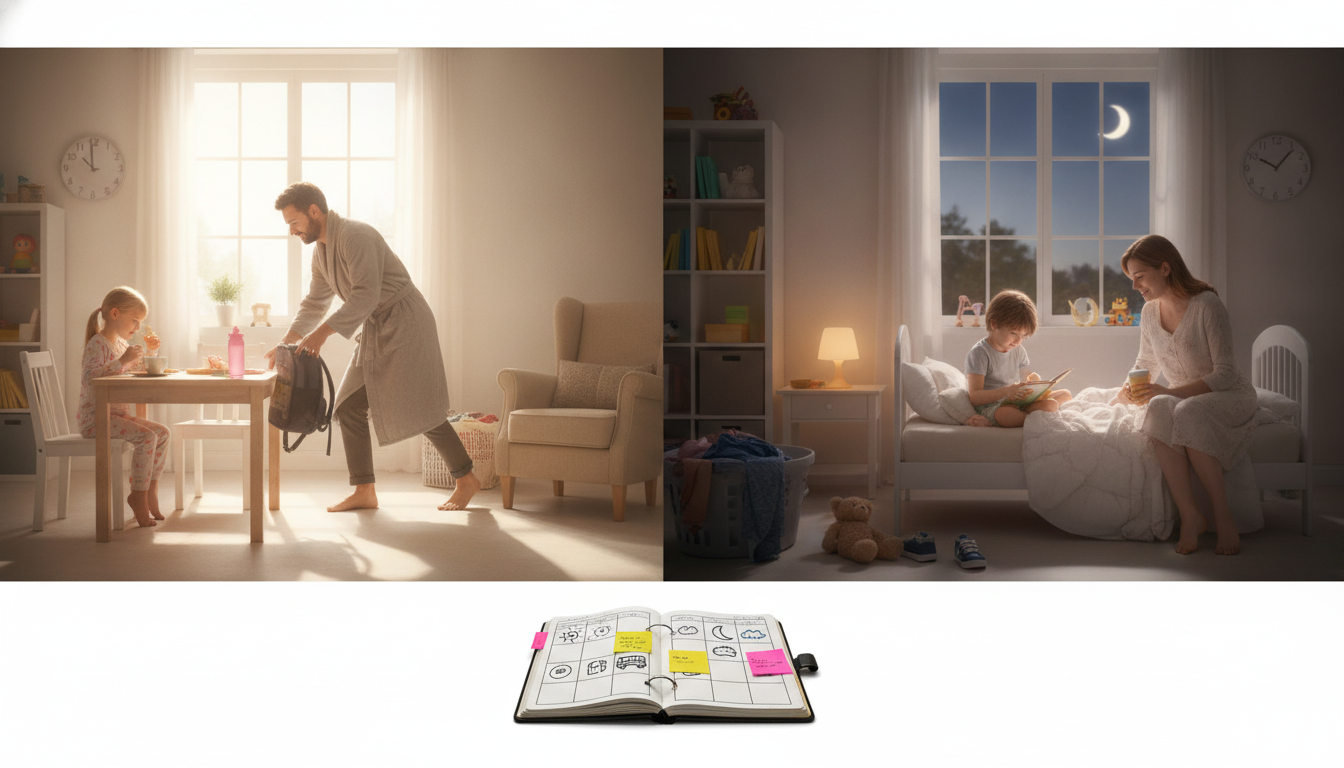
A shared spine is the handful of daily anchors that keep the household predictable. Once those are stable, each child’s unique needs can branch off without turning the day into chaos.
- Choose 3–5 shared anchors that happen every day (for example: breakfast, school run, dinner, bedtime wind-down).
- Attach kid-specific items as branches off the shared anchors (for example: Child A nap while Child B does homework).
- Keep transitions predictable: pack bags and prep clothing at the same point in the day, even if kids go to bed at different times.
- Use a simple visual system: one family calendar plus two color codes (one per child) to reveal conflicts instantly.
Sample weekday framework for two different schedules
| Time Block |
Shared Family Anchor |
Child A (younger) focus |
Child B (older) focus |
Parent focus |
| 6:30–8:00 |
Morning launch |
Breakfast + dress |
Breakfast + pack bag |
Coffee + quick tidy + final checks |
| 8:00–9:00 |
Drop-off window |
Daycare drop-off |
School drop-off |
Commute + start work |
| 12:00–2:00 |
Midday reset |
Nap/quiet time |
School/lunch |
Meal prep + admin tasks |
| 3:00–5:30 |
After-school flow |
Snack + play |
Snack + homework |
Rotate: homework help or supervised play |
| 5:30–7:30 |
Dinner + cleanup |
Dinner + bath (alternate days) |
Dinner + chores |
Cook once, clean once |
| 7:30–9:00 |
Evening wind-down |
Bedtime routine earlier |
Reading + lights out later |
Prep tomorrow + short recharge |
Use Transition Tools That Reduce Friction
When two schedules collide, transitions are where time disappears. A few “automation” habits reduce negotiation, searching, and repeated instructions.
Manage Overlap: When One Child Needs You and the Other Is Waiting
Food, Bedtime, and Activities: Simplify the Big Three
- Meals: Use a repeating menu template (2–3 breakfasts, 4–6 dinners) to cut decision fatigue, plus one flex night for leftovers.
- Bedtime: Keep routines consistent by sequence, not by effort—reuse the same steps (wash, pajamas, story) while adjusting length and lights-out. Prioritizing sleep supports mood, learning, and health; Harvard Health discusses why sleep matters in everyday functioning here.
- Activities: Limit split-location days. If both kids have events, consider naming one weekday the “busy day” and protecting one calmer weekday.
- Weekend planning: Choose one family block (outing/errands/visiting) and one recovery block (home time) so weekends don’t become a second workweek.
Keep It Fair Without Making It Identical
A Ready-to-Use Digital Guide and Templates
- For a plug-and-play setup, see the Managing Two Kids on Different Schedules Guide | Digital Parenting Resource for Busy Families, designed to help families map a “shared spine” and kid-specific branches.
- If meals are your biggest stress point, a simple checklist can make breakfast and snack planning faster—try the High-Protein Ideas for Muscle Recovery Checklist | Digital Download for Healthy High-Protein Breakfast Ideas for Muscle Recovery, Fitness, and Post-Workout Nutrition for quick, repeatable ideas you can rotate into a weekly template.
- Use any guide as a living document: review weekly, adjust one pain point at a time, and keep what’s working.
- If your household changes often (shift work, seasonal sports), save two versions: a “standard week” and a “busy week.”
FAQ
How can two kids have different bedtimes without constant arguments?
Keep the steps the same (wash, pajamas, story), and explain the difference simply: older kids often need less sleep. Give the earlier-bedtime child a predictable privilege (like choosing the story), and keep the later bedtime quiet and low-stimulation so the house stays calm.
What if naps overlap with school pickup or after-school activities?
Protect the nap with a backup plan: a stroller or car nap on pickup days, a shortened quiet-time alternative, or shifting the nap earlier by 15–30 minutes. Keep the same pre-nap cues so your child’s body recognizes it even when timing changes.
How often should a family schedule be adjusted?
Do a quick weekly review for small tweaks, and reassess more deeply every 6–8 weeks or when a major change hits (new school term, new activity season, or a developmental sleep shift). Change one element at a time so you can tell what actually improved the day.
Recommended for you







Leave a comment